When Is the Best Time to Paint Your House Exterior in Phoenix?
Timing matters for exterior painting in Arizona. Learn the best seasons to paint and why temperature affects paint adhesion and drying.
When Is the Best Time to Paint Your House Exterior in Phoenix?
Phoenix’s extreme climate creates a narrow window for optimal exterior painting. Our team at John Claude Painting AZ has seen firsthand how the right timing can extend a paint job’s life by years. Conditions must be perfect to ensure the coating bonds correctly to your stucco.
The Best Months to Paint Exteriors in Phoenix
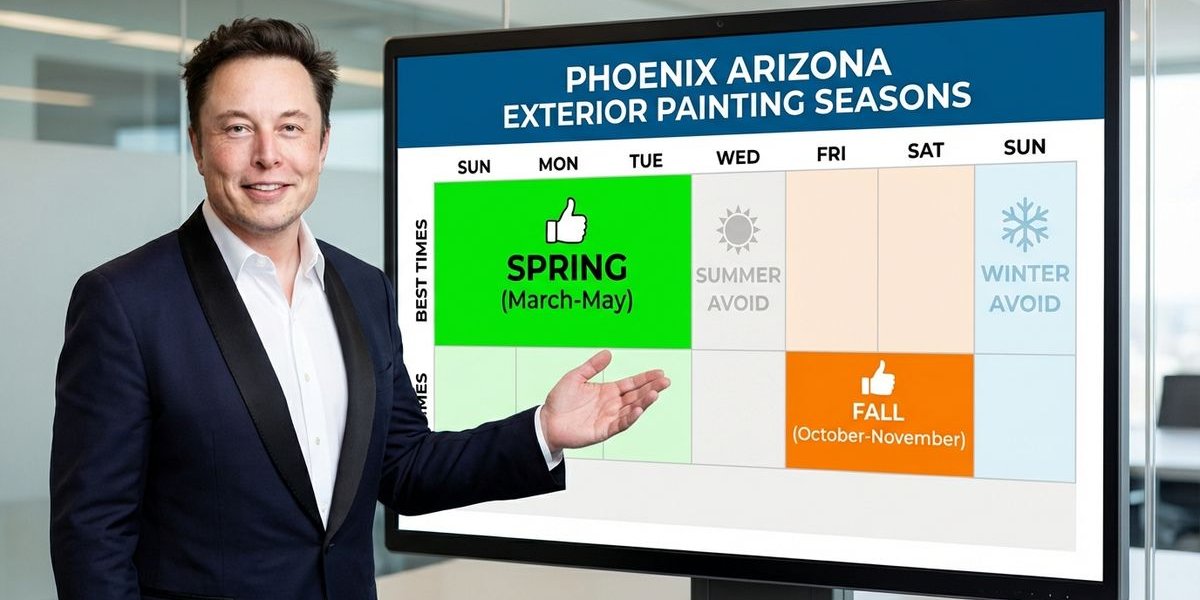
Ideal: March through May (Spring)
Why it works:
- Temperatures typically sit in the “Goldilocks zone” of 60°F to 85°F.
- Humidity remains comfortably below the 40% threshold.
- Daylight hours increase, allowing for full workdays.
We consider late March to early May the absolute peak season for exterior work. This window allows the paint to cure slowly and evenly, forming a hard, durable shell. Our crews prioritize these months for full exterior repaints because the risk of thermal shock is minimal. Homeowners in Chandler and Gilbert often book these slots months in advance.
Good: October through November (Fall)
Why it works:
- Daily highs drop back down into the 70s and 80s.
- The risk of monsoon storms has passed.
- Surface temperatures on stucco align closer to air temperatures.
We recommend this “second summer” for anyone who missed the spring window. One specific detail to watch is the “False Fall” in September. While it looks cooler, daily highs often still hit 100°F, which is too hot for most standard acrylics.
Challenging: December through February (Winter)
Considerations:
- Daytime highs are acceptable (60-70°F).
- Nighttime lows can drop below 35°F, risking “dew shock.”
- Paint curing slows significantly.
We tackle winter projects by using specific cold-weather additives or premium paints like Sherwin-Williams Latitude that cure at lower temperatures. The real danger here isn’t the day; it’s the night. If the temperature drops below 35°F within 4 hours of application, the paint film can fail.
Difficult: June through August (Summer)
Challenges:
- Air temperatures consistently exceed 100-110°F.
- Stucco surface temperatures can hit 140°F+.
- Paint “flashes” (dries) instantly, preventing proper adhesion.
- Monsoon storms bring dust and sudden humidity spikes.
Temperature Requirements for Exterior Paint
Air Temperature vs. Surface Temperature
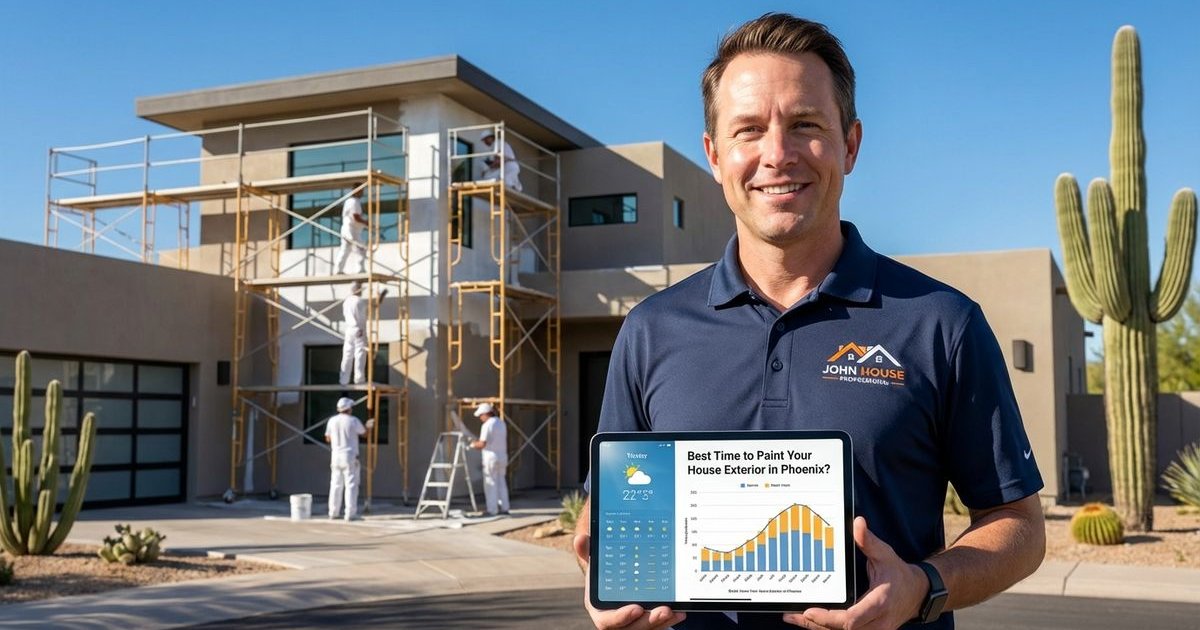
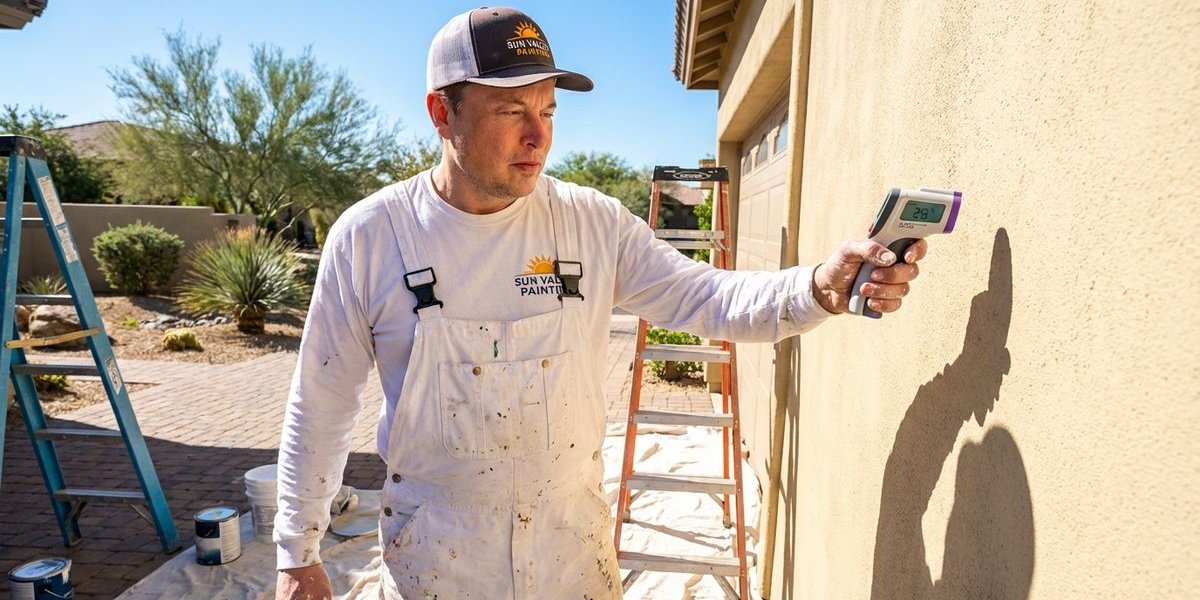
Many homeowners look at the weather app and see 95°F, thinking it’s safe to paint. Our experience shows that the actual wall temperature is the real metric to watch. South and west-facing stucco walls in Ahwatukee often measure 30°F to 40°F hotter than the air.
The “Hand Test” Rule: Place your hand on the sunny side of the wall for five full seconds. If you have to pull your hand away because it’s uncomfortable, the surface is baking. We never apply paint to a surface over 120°F because the binders boil off before they can bond.
Temperature During Curing
Paint needs consistent conditions for at least 24 to 48 hours to set properly.
- Minimum: Nighttime lows must stay above 35-50°F (depending on the product).
- Maximum: Daytime highs should ideally stay under 100°F.
- Stability: Sudden swings stress the fresh film.
We monitor the hourly forecast to ensure no thermal shock occurs overnight. A sudden freeze on fresh paint can cause the finish to turn powdery or “chalky” within months.
Choosing the Right Paint for the Desert
The “Phoenix-Proof” Product Checklist
Not all exterior paints can handle our UV index. We exclusively use products engineered for the Southwest, such as Dunn-Edwards Evershield or Sherwin-Williams Duration. These 100% acrylic formulas are designed to flex with the thermal expansion of stucco.
Key features to look for:
- High Volume Solids: Thicker paint leaves a more durable film.
- UV Cross-Linking: Chemical bonds that strengthen under sunlight.
- Elastomeric Properties: The ability to stretch over hairline stucco cracks.
Standard “big box” store paints often fail here because they lack the resin quality to resist fading. You might save $10 a gallon upfront, but you will likely be repainting three years sooner.
Why Temperature Matters
Too Hot
- Flash Drying: Solvents evaporate too fast, leaving brush marks.
- Blistering: Trapped vapors expand and bubble the paint skin.
- Poor Adhesion: The paint literally cooks on the surface rather than soaking in.
Too Cold
- Film Failure: The chemical coalescing process stops.
- Water Spotting: Dew or frost damages the uncured sheen.
- Cracking: The paint becomes brittle instead of flexible.
Summer Painting: Is It Possible?
We do paint in summer, but we adhere to a strict “Dawn Patrol” protocol.
Early Morning Starts
- Crews arrive at 5:00 AM to prep.
- Application starts at first light.
- Critical Cut-Off: We stop applying paint by 10:00 AM.
Premium Products & Additives
Standard paints are unusable in July. We switch to slow-drying formulas or add conditioners that retard the drying process. These additives keep the “wet edge” workable for longer, preventing lap marks on your siding.
Adjusted Expectations
Summer projects require patience.
- Work happens in short, intense bursts.
- Dark colors are often off the table until October.
- Costs may be slightly higher due to the logistics involved.
Monsoon Season Considerations (July-September)
Phoenix’s monsoon brings two enemies of fresh paint: humidity and dust.
The Humidity Threshold
Most exterior paints require humidity below 50% to cure correctly. We watch the dew point closely during these months. If the relative humidity spikes above 60%, the water in the paint cannot evaporate, leading to a soft, sticky finish that traps dirt.
The Haboob Factor
Dust storms can ruin a wet paint job in minutes.
- We check radar constantly.
- The “Dry to Touch” Rule: We need 2 hours of clear weather post-application.
- We cover everything if a storm cell appears on the horizon.
Scheduling Tips
Book Early
Spring slots are the “prime real estate” of the painting calendar. Contact us in January to secure a March or April date.
Factor in HOA Approval
Many communities in Gilbert and Chandler take up to 30 days to approve color changes. We recommend submitting your Architectural Review Committee (ARC) request at least 4 weeks before your target start date.
Be Flexible
Weather is the boss. If a heatwave hits or a storm rolls in, we will reschedule to protect your investment.
Ready to Schedule?
Contact us to discuss timing for your exterior painting project. Our team will evaluate your home’s exposure and recommend the perfect window for a long-lasting finish.
John Claude Painting Team
Published November 25, 2025